Familiarise yourself with the pension benefits
Earnings-related pensions help you in different life situations. In this section you will find information on the various pension benefits available for different life situations, how your pension amount is calculated and when and how you can claim the pension.
The most common earnings-related pension is the old-age pension. But earnings-related pensions provide for you also if you become disabled or if a wage earner in your family dies. You can retire on a partial old-age pension when you turn 62.
Most pensions are earnings-related pensions. You earn your earnings-related pension by working or by being a self-employed person. Earnings-related pensions are paid by pension providers. If your earnings-related pension is small, you may have a right to receive a national or a guarantee pension paid by Kela.
To find the general instructions on how to claim a pension from Finland or abroad, go to the section Claim your pension.
Earnings-related pension benefits based on your work are paid out one at a time
In most cases, you can only receive one work-related pension benefit at a time (such as an old-age pension, partial old-age pension, disability pension, or years-of-service pension), as these benefits are mutually exclusive. For example, you cannot get both a partial old-age pension and a (partial) disability pension at the same time. In rare cases, a pension from the public sector and a pension from the private sector may still be paid at the same time. An exception is the survivor’s pension, which you can receive in addition to another earnings-related pension benefit.
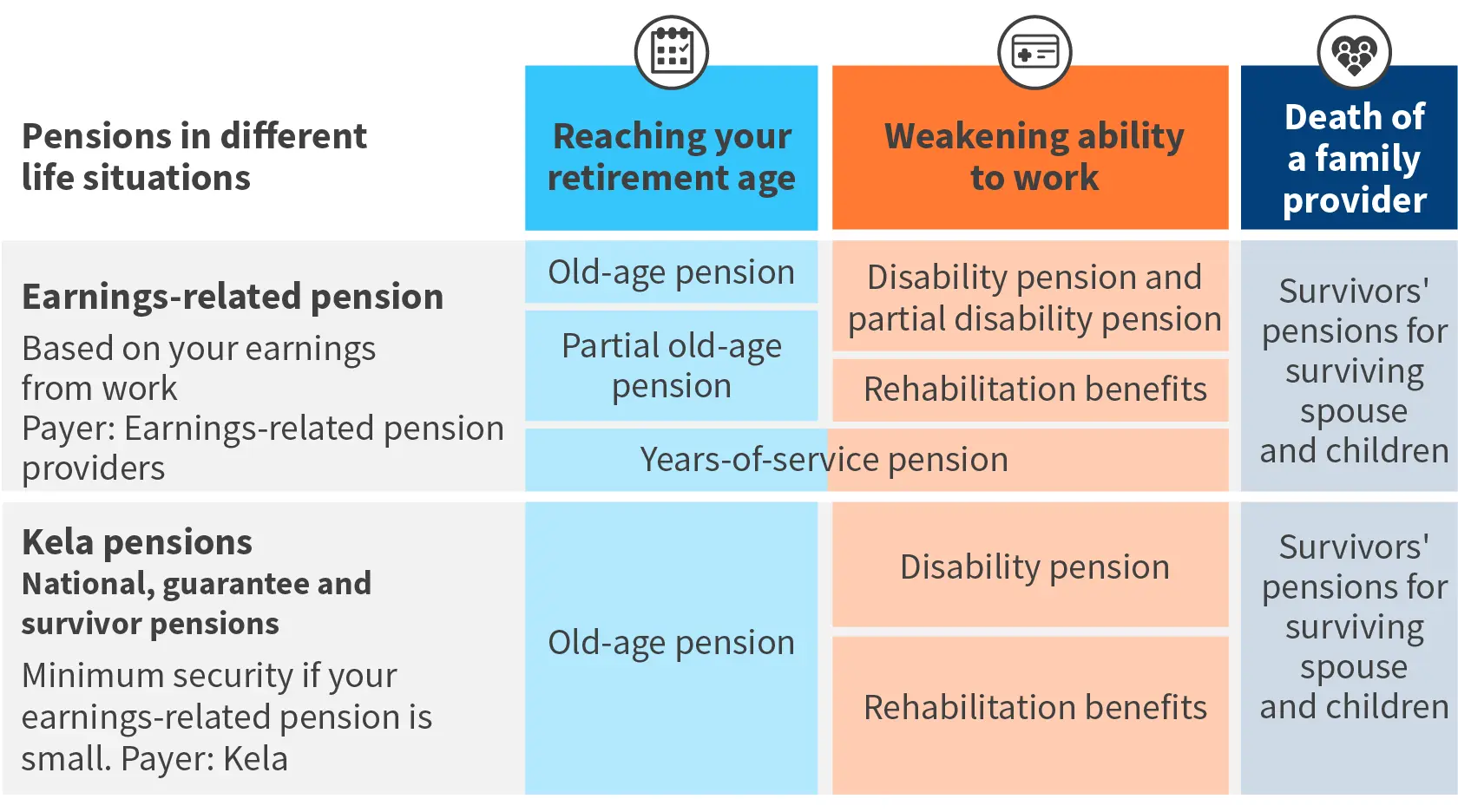
Pension benefits in brief
Old-age pension
An earnings-related pension provides you with a secure income after your working life. You can retire at the earliest when you reach the statutory retirement age for your age group. Your year of birth therefore determines when you can retire. The older you are when you retire, the higher your pension will be.
Read more and apply for a old-age pension
Partial old-age pension
When you are on a partial old-age pension, you can decide yourself how much you want to work, but you need to agree on any changes to your working hours with your employer. You can qualify for a partial old-age pension once you reach the minimum retirement age for your age group.
If you were born in 1964, you must have turned 62. If you were born in 1965 or later, you can draw a partial old-age pension up to three years before your own retirement age. The part of your pension that you take out early (before you reach your retirement) age will be permanently reduced.
Read more and apply for a partial old-age pension
Rehabilitation or disability pension
Rehabilitation is always a primary alternative if your work ability is reduced. Rehabilitation can help you continue working.
The disability pension is an option only once your illness, handicap or injury reduce your working ability in the long run, for more than one year.
Read more about rehabilitation
Read more and apply for a disability pension
Years-of-service pension
You may qualify for a years-of-service pension at the age of 63 if you have worked for at least 38 years in a job that requires great mental or physical effort and have a health condition that affects your ability to work.
Read more and apply for a years-of-service pension
Survivors’ pensions
The survivors’ pensions replace income that is lost when a family wage earner dies.
Read more and apply for a survivors’ pensions
You might also be interested in this
Updated: